
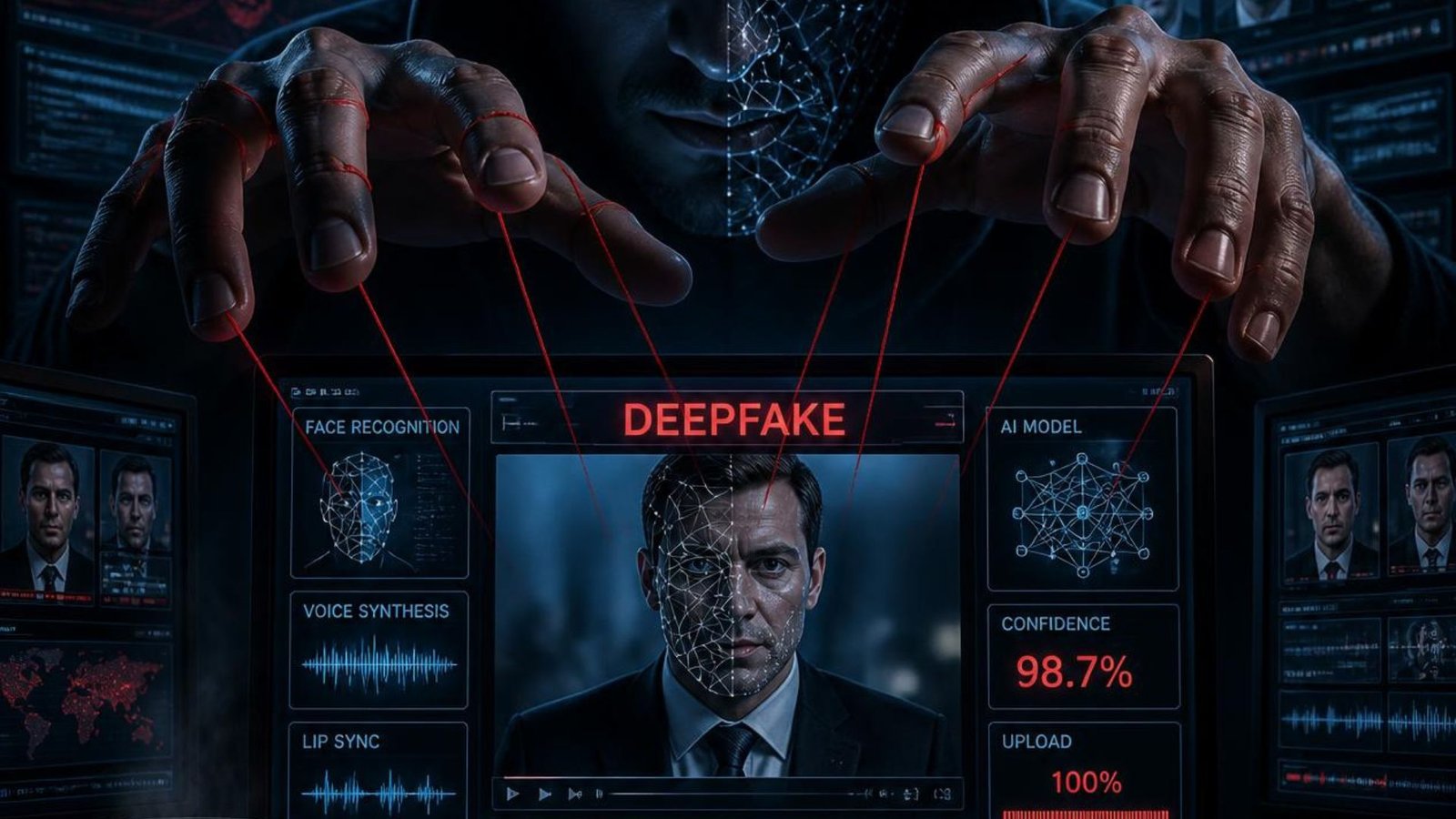

In early 2024, a finance employee at the engineering firm Arup joined a routine video call with the company’s CFO and several colleagues. He’d been suspicious of an earlier email requesting an urgent transfer — so the live call, with familiar faces and voices approving the request, was exactly what reassured him. He authorized 15 transfers totaling roughly $25.6 million. Every single person on that call except him was an AI-generated deepfake.
That one incident is the clearest answer to the question this guide exists to settle: are deepfakes actually a security threat, or just a novelty? They are a threat — a serious, growing, expensive one — but not for the reason most people assume. The danger isn’t that you’ll be fooled by an obviously fake video. It’s that deepfakes quietly dismantle the one thing humans have trusted for their entire lives: the evidence of their own eyes and ears. This guide explains how deepfake attacks actually work, why they defeat the defenses we rely on, and what genuinely protects you — in plain English, no prior knowledge required.
2. Why they’re a real security threat now
3. How a deepfake attack actually works
4. Why deepfakes defeat normal defenses
5. Can you just detect them?
6. What actually protects you
7. Frequently asked questions
1. What a deepfake actually is
A deepfake is synthetic media — audio, video, or images — generated by AI to convincingly imitate a real person. The name comes from “deep learning,” the technique behind it. You feed an AI model examples of someone’s face or voice, and it learns to produce new content in which that person appears to say or do things they never did. Early deepfakes were clumsy and easy to spot. Today’s are not.
The single most important thing to understand about modern deepfakes is how little raw material they need. Cloning a convincing version of someone’s voice now takes about three seconds of audio, producing roughly an 85% match. Three seconds. And the raw material is everywhere — a podcast appearance, a conference talk, an earnings call, a birthday video on social media, a voicemail greeting. Most executives, and increasingly most people, have far more than three seconds of their voice sitting in public. The barrier to impersonating someone is no longer skill or expensive equipment. It’s a short clip anyone can find.
2. Why they’re a real security threat now
For most of the deepfake era, the public conversation was about politics — fake videos of world leaders, election disinformation. That framing made deepfakes feel like a societal problem for platforms and governments. Meanwhile, the technology quietly found its most profitable home somewhere else entirely: corporate finance departments and everyday fraud.
The numbers have moved from “emerging concern” to “active crisis.” In 2025, the FBI’s Internet Crime Complaint Center logged roughly $893 million in AI-enabled fraud losses — the first year it tracked AI as its own category, and almost certainly an undercount since most incidents go unreported. Deloitte projects generative-AI-enabled fraud in the US could climb from $12.3 billion in 2023 to $40 billion by 2027. Surveys show a majority of organizations now report encountering at least one deepfake attack in the past year. This is no longer a hypothetical filed under “future risks.” It is a line item in fraud reports today.
3. How a deepfake attack actually works
A serious deepfake attack rarely starts with the fake. It starts with research. Attackers study a target organization using public sources — who the executives are, who works in finance, when leaders are traveling, what deals are in progress. They’re looking for a plausible scenario and a believable pretext, the same groundwork behind any well-run social engineering operation.
Then they build the fake and stage the scenario. The Arup case is the textbook example, and it’s worth walking through because every step is instructive. The finance employee first received a phishing email impersonating the CFO about a confidential transaction. He was suspicious — which is exactly what a well-trained employee should be. So the attackers escalated to the thing that would overcome his suspicion: a live video call. On that call were the “CFO” and several “colleagues,” all AI-generated, discussing the transaction as if it were routine. Seeing and hearing familiar people in real time did what the email couldn’t — it manufactured trust. He authorized the transfers. Arup’s own Chief Information Officer later described it precisely: this was an attack on psychology, not on technology.
That framing is the key to the whole thing. The deepfake didn’t hack a system. It hacked a human decision, by fabricating the exact evidence that human was trained to rely on. The most modern versions of these attacks are multimodal and sequential: an email arrives first, then a follow-up voice call, then a video meeting — each channel reinforcing the last, building cumulative credibility across every medium the victim would normally use to verify the truth. The verification steps became the attack surface.
4. Why deepfakes defeat normal defenses
Here’s the part that makes deepfakes genuinely dangerous rather than merely new: they don’t just add an attack, they specifically dismantle the defenses built to stop the previous generation of fraud. For years, the standard protection against fake-CEO wire fraud was verification through a “real” channel. Suspicious email? Call the person to confirm. Unsure about a request? Get them on video. These controls worked by forcing the fraud out of the easily-faked channel and into one that supposedly couldn’t be faked — a real voice, a real face.
Watch each one collapse. The callback offers no protection when the voice answering is a clone indistinguishable from the real person. The video-call verification provides nothing when the video is generated in real time. And the two-person approval rule — the four-eyes principle — fails completely when both reviewers are sitting on the same fabricated call, watching several supposed executives approve the same transaction together. The attackers didn’t defeat these controls by breaking them. They defeated them by satisfying them with fakes. That is the shift that makes deepfakes a category threat rather than just another scam.
5. Can you just detect them?
The instinct is “train people to spot the fakes.” But research shows humans correctly identify high-quality deepfake video only about a quarter of the time — worse than a coin flip. You cannot train your way to reliably detecting something built specifically to be undetectable.
Detection is a losing game, and it’s important to understand why, because a lot of money is being spent pretending otherwise. Human perception is the weakest link: studies put people’s accuracy at spotting good deepfake video around 24.5%. Detection software does better in the lab — some tools reach 96% accuracy — but that accuracy drops by 45 to 50% in real-world conditions, and every improvement in detection is met by an improvement in generation. It’s an arms race where the defender is permanently one step behind, because the attacker gets to test against the detector before striking.
This doesn’t mean detection tools are useless — they’re a helpful layer. But treating “we’ll detect the fakes” as your primary defense is building your security on the one thing the technology is specifically designed to defeat. If your plan depends on a human or a tool noticing that a face or voice is synthetic in the moment, your plan will eventually fail, because the fakes are getting better faster than the detectors are.
6. What actually protects you
The durable defense against deepfakes isn’t better detection — it’s process redesign that removes the need to judge authenticity at all. Once you accept that you cannot reliably tell a real face or voice from a fake one, the solution becomes clear: stop making authenticity the thing that authorizes an action. Verify the real person through something a deepfake cannot reproduce.
In practice, that means a few concrete habits. The most important is out-of-band verification: when a request carries urgency and involves money or access, confirm it through a separate, trusted channel you initiate yourself — not the number in the email, not a callback on the same video call, but a channel you already trust, reached the way you always reach it. Beyond that, high-value transfers should require dual approval through independent channels rather than approval given inside a single call. Some organizations use pre-agreed code words for sensitive requests — something no deepfake can know. And unusual or urgent transfer requests should trigger a mandatory hold, because urgency is the attacker’s primary weapon and a built-in pause defuses it.
The mental model to carry from all of this: stop treating perception as proof. For your entire life, seeing and hearing someone was conclusive evidence of who they were. That instinct is now a vulnerability an attacker can exploit directly. Identity can no longer rest on anything an attacker is able to reproduce — and an attacker can now reproduce a face and a voice. So identity has to rest on something they can’t: a verification step that doesn’t depend on how someone looks or sounds. Done right, a successful impersonation still fails, because the fake face and voice were never what authorized the action in the first place.
7. Frequently asked questions
Are deepfakes actually a real security threat?
Yes. They’ve moved from novelty to active fraud category. The FBI logged roughly $893 million in AI-enabled fraud in 2025, and a single deepfake video call cost the firm Arup about $25.6 million. Surveys show most organizations have now encountered at least one deepfake attack.
How much does it take to clone someone’s voice?
About three seconds of audio can produce a roughly 85% voice match using publicly available tools. Most people have far more than that online — in videos, podcasts, voicemails, and social posts.
Can people tell when a video is a deepfake?
Usually not. Research shows humans correctly identify high-quality deepfake video only about 24.5% of the time — worse than chance. Detection software helps but loses much of its accuracy in real-world conditions, so it can’t be your only defense.
What are the warning signs of a deepfake video call?
Possible visual tells include lip-sync drift, glassy eyes, odd reflections, mismatched lighting, and warping around the hairline. But the most reliable red flag is behavioral: an urgent, confidential request that pressures you to skip normal approval steps. Trust the process, not your eyes.
How do you actually defend against deepfake fraud?
Through process, not detection. Verify sensitive requests out-of-band through a channel you initiate, require dual approval for high-value transfers, use pre-agreed code words, and put a mandatory hold on urgent unusual requests. The goal is to make the fake face or voice irrelevant to the decision.
Security, Decoded.
If this reframed deepfakes for you, you’ll like the newsletter. One security idea, decoded clearly, every week — free.
Subscribe to SKB Decoded →